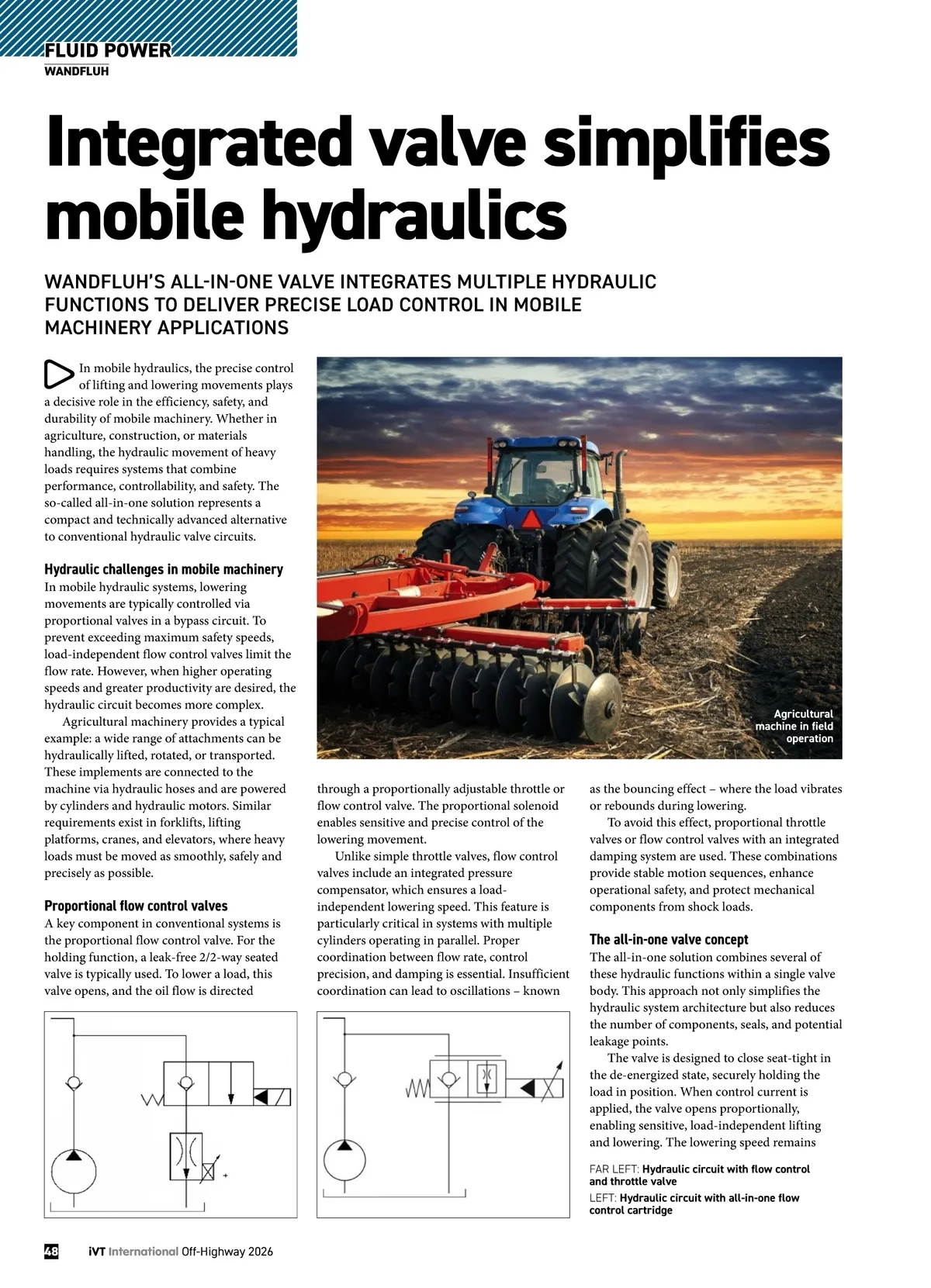
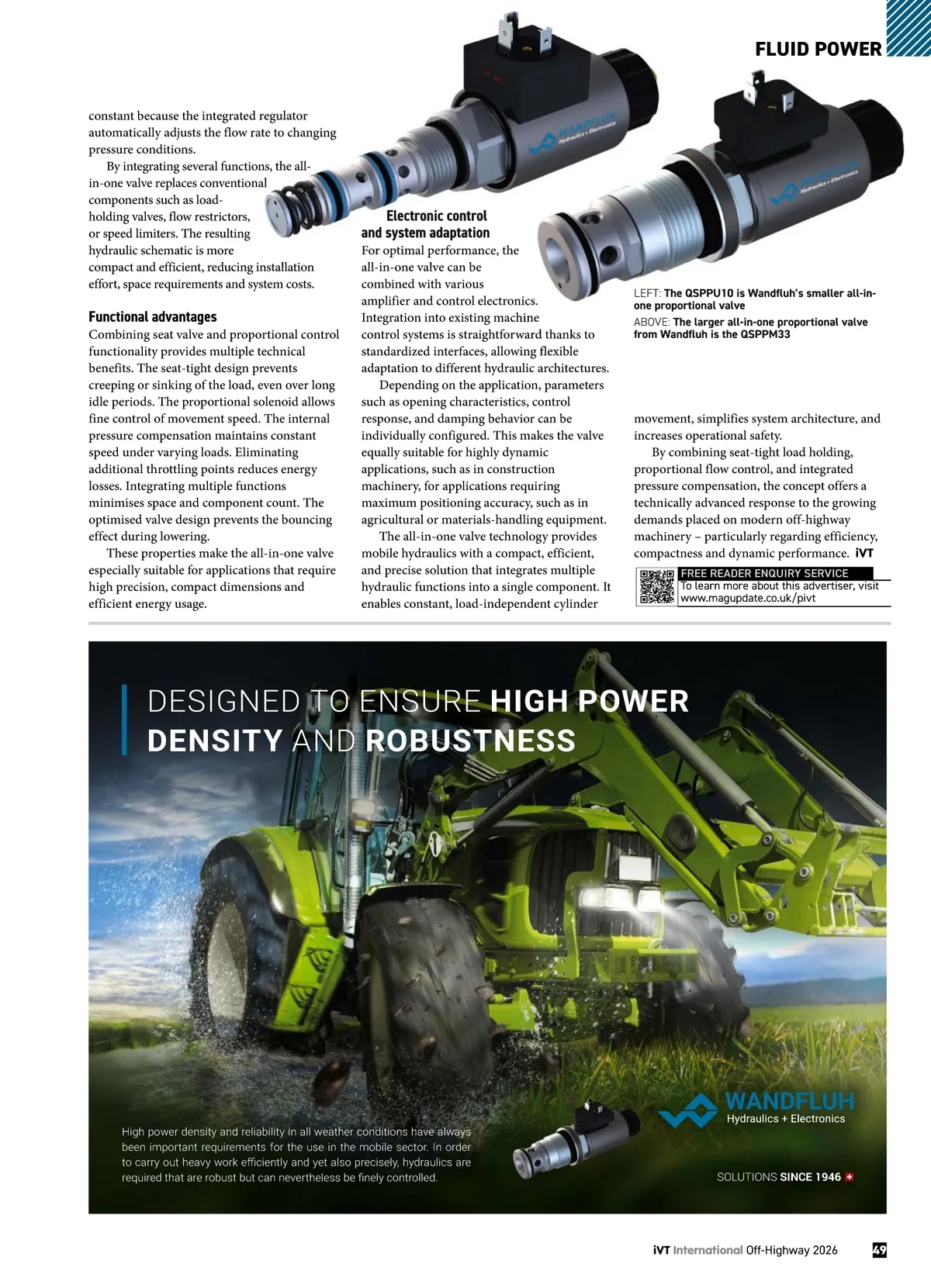
WANDFLUH FLUID POWER Integrated valve simplifies mobile hydraulics WANDFLUH’S ALL-IN-ONE VALVE INTEGRATES MULTIPLE HYDRAULIC FUNCTIONS TO DELIVER PRECISE LOAD CONTROL IN MOBILE MACHINERY APPLICATIONS In mobile hydraulics, the precise control of lifting and lowering movements plays a decisive role in the efficiency, safety, and durability of mobile machinery. Whether in agriculture, construction, or materials handling, the hydraulic movement of heavy loads requires systems that combine performance, controllability, and safety. The so-called all-in-one solution represents a compact and technically advanced alternative to conventional hydraulic valve circuits. Hydraulic challenges in mobile machinery In mobile hydraulic systems, lowering movements are typically controlled via proportional valves in a bypass circuit. To prevent exceeding maximum safety speeds, load-independent flow control valves limit the flow rate. However, when higher operating speeds and greater productivity are desired, the hydraulic circuit becomes more complex. Agricultural machinery provides a typical example: a wide range of attachments can be hydraulically lifted, rotated, or transported. These implements are connected to the machine via hydraulic hoses and are powered by cylinders and hydraulic motors. Similar requirements exist in forklifts, lifting platforms, cranes, and elevators, where heavy loads must be moved as smoothly, safely and precisely as possible. Agricultural machine in field operation Proportional flow control valves A key component in conventional systems is the proportional flow control valve. For the holding function, a leak-free 2/2-way seated valve is typically used. To lower a load, this valve opens, and the oil flow is directed through a proportionally adjustable throttle or flow control valve. The proportional solenoid enables sensitive and precise control of the lowering movement. Unlike simple throttle valves, flow control valves include an integrated pressure compensator, which ensures a load-independent lowering speed. This feature is particularly critical in systems with multiple cylinders operating in parallel. Proper coordination between flow rate, control precision, and damping is essential. Insufficient coordination can lead to oscillations – known as the bouncing effect – where the load vibrates or rebounds during lowering. To avoid this effect, proportional throttle valves or flow control valves with an integrated damping system are used. These combinations provide stable motion sequences, enhance operational safety, and protect mechanical components from shock loads. The all-in-one valve concept The all-in-one solution combines several of these hydraulic functions within a single valve body. This approach not only simplifies the hydraulic system architecture but also reduces the number of components, seals, and potential leakage points. The valve is designed to close seat-tight in the de-energized state, securely holding the load in position. When control current is applied, the valve opens proportionally, enabling sensitive, load-independent lifting and lowering. The lowering speed remains FAR LEFT: Hydraulic circuit with flow control and throttle valve LEFT: Hydraulic circuit with all-in-one flow control cartridge 48 iVT International Off-Highway 2026
Industrial Vehicle Technology Off-Highway Annual 2026: Page 48