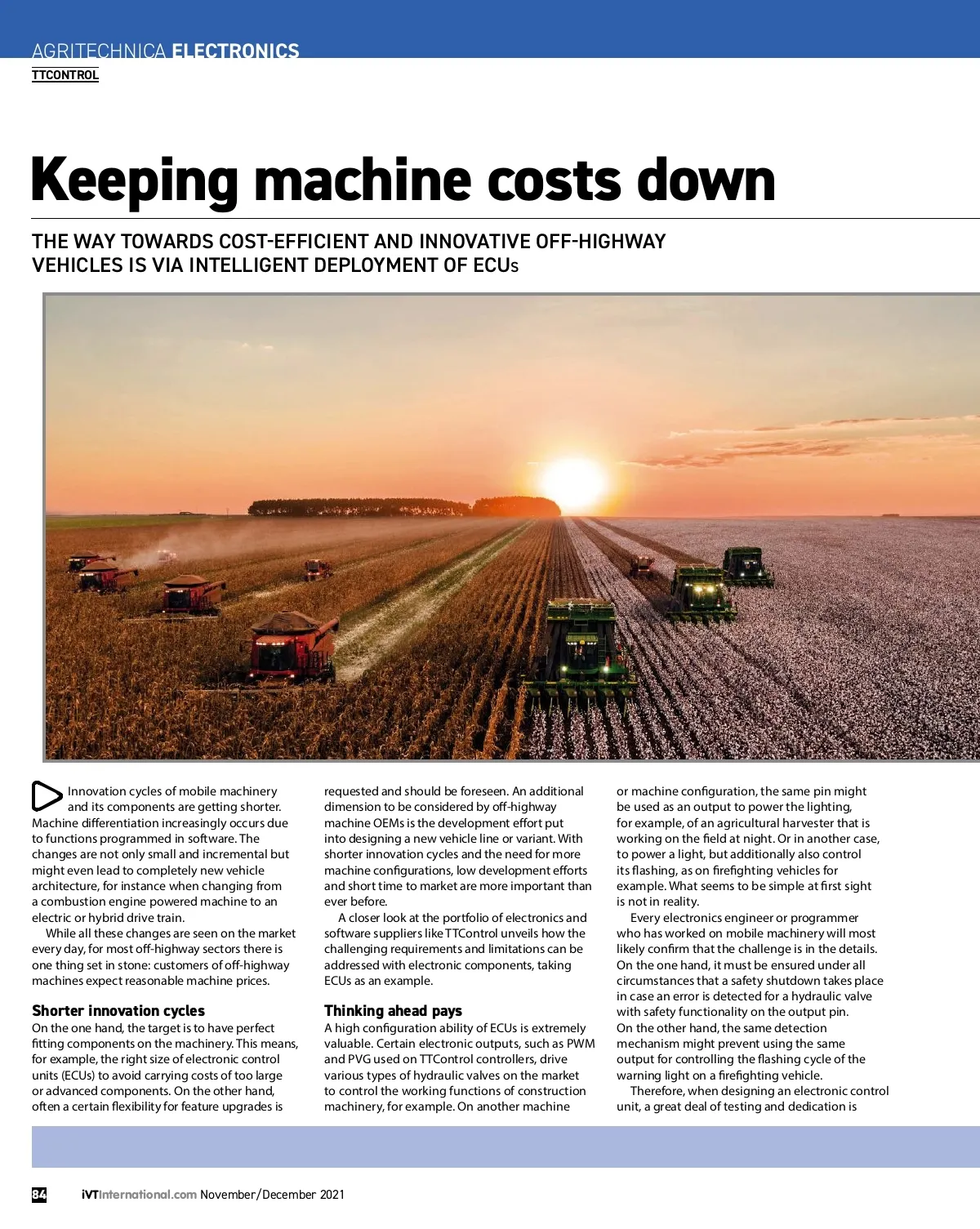
AGRITECHNICA ELECTRONICS TTCONTROL Keeping machine costs down THE WAY TOWARDS COST-EFFICIENT AND INNOVATIVE OFF-HIGHWAY VEHICLES IS VIA INTELLIGENT DEPLOYMENT OF ECU S Innovation cycles of mobile machinery and its components are getting shorter. Machine differentiation increasingly occurs due to functions programmed in software. The changes are not only small and incremental but might even lead to completely new vehicle architecture, for instance when changing from a combustion engine powered machine to an electric or hybrid drive train. While all these changes are seen on the market every day, for most off-highway sectors there is one thing set in stone: customers of off-highway machines expect reasonable machine prices. requested and should be foreseen. An additional dimension to be considered by off-highway machine OEMs is the development effort put into designing a new vehicle line or variant. With shorter innovation cycles and the need for more machine configurations, low development efforts and short time to market are more important than ever before. A closer look at the portfolio of electronics and software suppliers like TTControl unveils how the challenging requirements and limitations can be addressed with electronic components, taking ECUs as an example. Shorter innovation cycles On the one hand, the target is to have perfect fitting components on the machinery. This means, for example, the right size of electronic control units (ECUs) to avoid carrying costs of too large or advanced components. On the other hand, often a certain flexibility for feature upgrades is Thinking ahead pays A high configuration ability of ECUs is extremely valuable. Certain electronic outputs, such as PWM and PVG used on TTControl controllers, drive various types of hydraulic valves on the market to control the working functions of construction machinery, for example. On another machine or machine configuration, the same pin might be used as an output to power the lighting, for example, of an agricultural harvester that is working on the field at night. Or in another case, to power a light, but additionally also control its flashing, as on firefighting vehicles for example. What seems to be simple at first sight is not in reality. Every electronics engineer or programmer who has worked on mobile machinery will most likely confirm that the challenge is in the details. On the one hand, it must be ensured under all circumstances that a safety shutdown takes place in case an error is detected for a hydraulic valve with safety functionality on the output pin. On the other hand, the same detection mechanism might prevent using the same output for controlling the flashing cycle of the warning light on a firefighting vehicle. Therefore, when designing an electronic control unit, a great deal of testing and dedication is 84 iVTInternational.com November/December 2021
Industrial Vehicle Technology November/December 2021: Page 84